What is it?
Real world
- Social media
- When a person updates his status – all his followers gets the notification
- A follower can follow or unfollow another person at any point of time
- Once unfollowed, person will not get the notifications from subject in future
Real world diagram
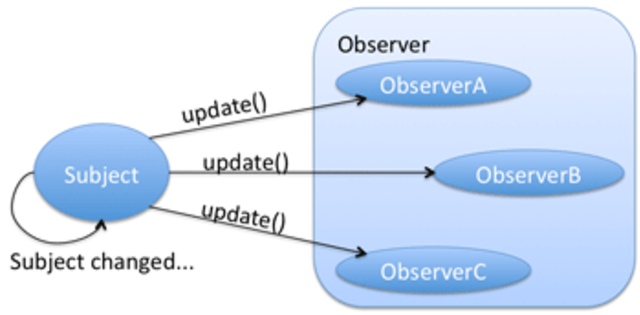
- One-to-many dependencies between objects
- Also known as publish-subscribe pattern
- There are many observers (subscriber objects) that are observing a particular subject (publisher object)
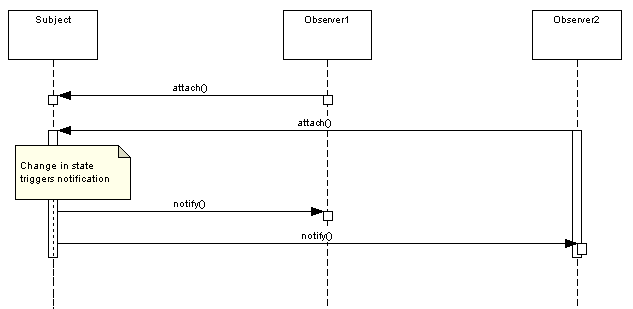
- Observers register themselves to a subject to get a notification when there is a change made inside that subject
Sequence diagram
Architecture
Coding example
Subject and concreteSubject
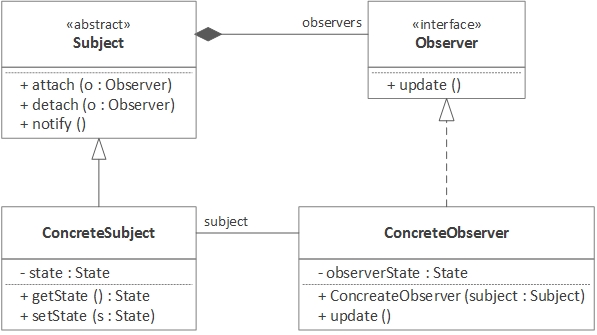
- Subject – interface or abstract class defining the operations for attaching and de-attaching observers to the subject
- ConcreteSubject – concrete Subject class. It maintain the state of the object and when a change in the state occurs it notifies the attached Observers
// Subject
public interface Subject
{
    public void attach(Observer o);
    public void detach(Observer o);
    public void notifyUpdate(Message m);
}
// MessagePublisher.java
import java.util.ArrayList;
import java.util.List;

public class MessagePublisher implements Subject {

    private List<Observer> observers = new ArrayList<>();

    @Override
    public void attach(Observer o) {
        observers.add(o);
    }

    @Override
    public void detach(Observer o) {
        observers.remove(o);
    }

    @Override
    public void notifyUpdate(Message m) {
        for(Observer o: observers) {
            o.update(m);
        }
    }
}
Observer and ConcreteObservers
- Observer – interface or abstract class defining the operations to be used to notify this object
- ConcreteObserver – concrete Observer implementations
// Observer.java
public interface Observer
{
    public void update(Message m);
}
// MessageSubscriberOne.java
public class MessageSubscriberOne implements Observer
{
    @Override
    public void update(Message m) {
        System.out.println("MessageSubscriberOne :: " + m.getMessageContent());
    }
}

// MessageSubscriberTwo.java
public class MessageSubscriberTwo implements Observer
{
    @Override
    public void update(Message m) {
        System.out.println("MessageSubscriberTwo :: " + m.getMessageContent());
    }
}

// MessageSubscriberThree.java
public class MessageSubscriberThree implements Observer
{
    @Override
    public void update(Message m) {
        System.out.println("MessageSubscriberThree :: " + m.getMessageContent());
    }
}
State object
This must be an immutable object so that no class can modify it’s content by mistake
// Message.java
public class Message
{
    final String messageContent;

    public Message (String m) {
        this.messageContent = m;
    }

    public String getMessageContent() {
        return messageContent;
    }
}
Test communication between publisher and subscribers
// Main.java
public class Main
{
    public static void main(String[] args)
    {
        MessageSubscriberOne s1 = new MessageSubscriberOne();
        MessageSubscriberTwo s2 = new MessageSubscriberTwo();
        MessageSubscriberThree s3 = new MessageSubscriberThree();

        MessagePublisher p = new MessagePublisher();

        p.attach(s1);
        p.attach(s2);

        p.notifyUpdate(new Message("First Message"));   //s1 and s2 will receive the update

        p.detach(s1);
        p.attach(s3);

        p.notifyUpdate(new Message("Second Message")); //s2 and s3 will receive the update
    }
}
// Console output
MessageSubscriberOne :: First Message
MessageSubscriberTwo :: First Message

MessageSubscriberTwo :: Second Message
MessageSubscriberThree :: Second Message
Leave a Reply